Why Exercise Is Restricted After a Hair Transplant
A hair transplant is a surgical procedure. Follicular units are extracted from the donor area and individually placed into recipient sites created across the scalp. In the days that follow, those grafts are not yet anchored by new tissue — they are held in place by dried plasma and the natural clotting process. They are at their most vulnerable in the first 7 to 14 days.
Three specific risks make early exercise a genuine threat to your result:
Exercise raises systemic blood pressure. In the scalp, this increased vascular pressure can cause minor bleeding at graft sites and, in the early days, physically dislodge grafts that have not yet formed new tissue anchors.
Sweat contains salt, urea, and lactic acid. Excessive sweating across the scalp in the first two weeks irritates open wound sites, softens healing scabs prematurely, and creates conditions where bacterial infection and folliculitis become significantly more likely.
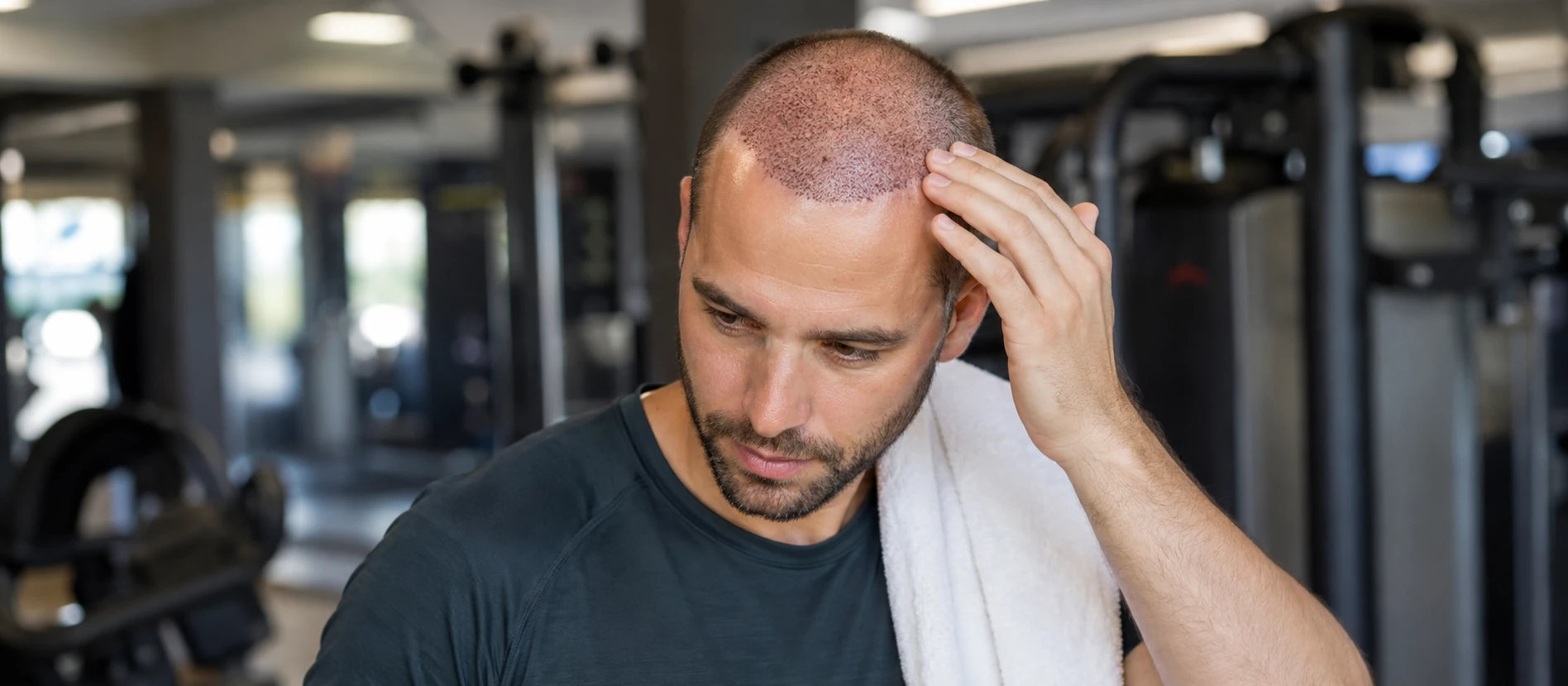
Strenuous activity involving bending, straining, or contact with the scalp — through gym equipment, helmets, sports headgear, or impact — can directly dislodge grafts that are not yet secured. Even wiping sweat roughly from the forehead carries this risk in the first week.
Patients in Delhi, Ludhiana, and Bangalore face ambient temperatures of 32 to 45°C during summer months. Outdoor activity in this heat produces sweating at a rate that would be unusual in cooler climates. Even a short walk in peak summer can generate the kind of scalp perspiration that carries risk in the first two weeks post-surgery.
Week-by-Week Exercise Timeline After a Hair Transplant
There is no single clearance date for returning to exercise. Different activities carry different levels of risk, and the timeline reflects that. The breakdown below applies to patients who have had a FUE hair transplant. FUT patients should refer to the technique-specific guidance in the next section.
1–3
The scalp is in its most vulnerable state. Grafts are held only by initial clotting. Even gentle exertion that elevates heart rate is inadvisable. Short, slow walks within the home or clinic are acceptable. No outdoor walking in heat, no climbing stairs briskly, no lifting anything heavier than 5 kg. Sleep with head elevated at 30 to 45 degrees to minimise swelling.
4–7
Gentle flat-surface walking of 15 to 20 minutes is appropriate, provided it does not produce sweating. In Indian summers, restrict this to air-conditioned indoor environments or early morning before 7 AM. Do not walk in direct sunlight. Avoid any activity that involves bending the head forward, heavy bags, or effort that raises your heart rate noticeably.
2
Light bodyweight exercises — gentle squats, slow treadmill walking at flat incline — become possible for most patients by the end of week 2, provided scabs have healed and there is no scalp irritation. The no-sweating rule still applies. Stop immediately if you feel your scalp becoming warm or moist. Gym sessions must be in air-conditioned environments only at this stage.
3
Most patients can progress to brisk walking, slow jogging, light resistance machines, and standing yoga poses from week 3 onwards. Avoid yoga inversions (downward dog, headstands, forward folds) until week 6. Monitor scalp response after each session — if redness, itching, or swelling increases, reduce intensity and allow more healing time.
4
By the four-week mark, grafts are well anchored and most regular gym activities can resume. Moderate weights at 50 to 60 percent of your usual working load, jogging, cycling, and group fitness classes are appropriate for the majority of patients. Continue to avoid contact sports, heavy compound lifts, and anything involving headgear pressing on the scalp.
6–8
Full training load, including HIIT, heavy compound lifts, and high-intensity cardio, is typically safe from week 6 to 8. The scalp is fully healed, grafts are anchored, and normal physiological stress from exercise no longer poses a risk to the transplant result. Return to your pre-surgery workout intensity progressively rather than all at once.
3+
Swimming in chlorinated pools, contact sports including cricket, football, kabaddi, and martial arts, and any activity involving helmets or headgear are safe from the three-month mark in most patients. By this point the scalp is fully healed and follicles are well into the active growth phase of their recovery cycle.
FUE vs FUT: Does the Technique Affect Your Exercise Timeline?
The surgical technique used for your transplant has a direct bearing on certain exercise restrictions — particularly those involving the donor area. FUE and FUT create different wound types at the back of the scalp, and this matters for how quickly you can return to specific movements.
| Activity | FUE Timeline | FUT Timeline |
|---|---|---|
| Gentle walking | Day 4 to 5 | Day 5 to 7 (donor tightness) |
| Light bodyweight exercises | Week 2 | Week 2 to 3 |
| Moderate cardio / jogging | Week 3 | Week 4 (avoid neck strain) |
| Gym — moderate weights | Week 4 | Week 5 to 6 |
| Heavy lifting / HIIT | Week 6 to 8 | Week 8 to 10 |
| Upper back / neck exercises | Week 4 | Week 8 to 10 (scar stretch risk) |
| Contact sports / swimming | Month 3 | Month 3 to 4 |
The critical FUT-specific restriction is upper back and neck exercises. The strip donor scar at the back of the scalp can stretch if exercises involving the neck and upper back muscles — such as deadlifts, overhead press, pull-ups, and neck rolls — are resumed too early. A stretched scar becomes more visible long-term. FUT patients should discuss this specifically with their surgeon before returning to these movements.
Specific Activities: When Is Each One Safe?
Patients often have questions about a specific activity rather than a general timeline. Here is clear guidance on the activities most commonly asked about at IHT post-operative consultations.
Light bodyweight from week 2. Moderate weights (50 to 60 percent load) from week 4. Heavy compound lifts — deadlifts, squats, bench press at full load — from week 6 to 8. Heavy lifting raises intra-abdominal and intracranial pressure, which can stress the healing scalp even when you are not touching it.
Slow treadmill walking from week 2 in an AC environment. Jogging outdoors from week 3, provided temperature is below 30°C and it is not peak sun hours. Full running intensity from week 4. In Indian summers, restrict outdoor running to early morning (before 7 AM) for the first month regardless of technique.
Standing and seated poses with no inversion from week 3. Full practice including inversions (downward dog, headstands, shoulder stands, forward folds) from week 6 onwards. Inversions redirect blood flow toward the scalp, which can increase swelling and disrupt healing grafts if done too early.
Avoid for a minimum of 4 to 6 weeks. Cricket involves prolonged outdoor sun exposure, significant physical exertion, and for fielders the risk of sudden head impact. Batting and bowling generate rotational forces and elevated heart rate. Resume only after full surgical clearance and complete scab resolution.
Avoid for at least 3 months. Chlorinated pool water and salt water both irritate healing grafts. Prolonged scalp moisture exposure slows the healing process and increases infection risk. Open water swimming additionally carries the risk of physical contact with waves and currents. This is one of the last activities to receive clearance.
Helmet use must be avoided for 3 to 4 weeks minimum. A helmet presses directly on recipient grafts, creates friction, traps heat, and causes localised sweating beneath the scalp. If commuting is essential, consider travelling by auto or car for the first month. Some surgeons allow a loose cotton cap beneath a helmet after week 3 — confirm this with your own surgeon before attempting it.
The Sweating Problem: Why Indian Patients Need Extra Caution
Most international hair transplant recovery guides are written for patients in Europe or North America, where ambient temperatures during recovery are typically between 15 and 25°C. In India, patients recovering in summer months may face temperatures of 38 to 45°C with high humidity. This changes the calculation for exercise significantly.
What sweat actually does to healing grafts
Sweat does not directly dislodge grafts once they have initial clot anchoring. But excessive scalp sweating in the first two weeks does three things that compromise recovery: it softens healing scabs before they are ready to detach naturally, it introduces salt and bacteria to open wound sites, and it creates a warm, moist microenvironment that accelerates bacterial growth and raises the risk of folliculitis.

Practical strategies for Indian patients
Patients who have had a hair transplant in Delhi or hair transplant in Ludhiana during April through July need to take the summer heat seriously as a recovery variable. Practical measures that reduce sweating risk include:
- Limiting outdoor time to before 7 AM and after 7 PM for the first three weeks
- Keeping indoor environments air-conditioned at 22 to 24°C during the recovery window
- Avoiding any form of exercise that produces scalp sweating until week 3
- If mild sweating occurs, gently dab — never wipe — with a clean, dry tissue
- Staying well-hydrated to support overall healing, even during exercise restriction
- Scheduling the transplant procedure for cooler months (October to February) if recovery during peak summer is a concern
Exercise Dos and Don’ts After a Hair Transplant
- Walk gently indoors from day 4 in a temperature-controlled environment
- Return to gym activity in a phased way — walking first, then light resistance, then moderate cardio, then full load
- Exercise in air-conditioned environments only for the first three weeks
- Wear loose, breathable fabrics that do not make contact with the scalp or recipient area
- Shower promptly after any exercise session once your surgeon clears you for regular washing
- Carry a clean tissue and gently dab the scalp if you feel warmth or moisture building
- Get explicit clearance from your surgeon before resuming each new activity tier
- Monitor scalp response after every session — redness or tenderness means slow down
- Do not go to the gym or do any exercise that causes scalp sweating in the first two weeks
- Do not wear helmets, tight caps, headbands, or anything pressing against the scalp for 3 to 4 weeks
- Avoid outdoor exercise in direct sun for at least four weeks — the unprotected scalp burns easily
- Do not do yoga inversions, headstands, or any pose placing the head below the heart for six weeks
- Avoid heavy compound lifts — deadlifts, squats, overhead press at full load — for 6 to 8 weeks
- Do not swim in any pool, river, or sea for at least three months
- Avoid contact sports, cricket, football, or martial arts for at least 4 to 6 weeks
- Do not use steam rooms, saunas, or hot tubs for at least one month
When to Call Your Surgeon After Exercising
Most patients who follow the phased timeline recover without complications. However, if you exercised too early or notice any of the following after physical activity, contact your IHT surgeon promptly rather than waiting for your next scheduled appointment.
- Increased bleeding or oozing from any graft sites after physical activity
- Noticeable swelling in the forehead or scalp that was not present before exercise
- Small pimples or pustules appearing in the recipient or donor area after sweating
- Grafts visibly dislodged or missing from their implanted positions
- Persistent pain or throbbing in the scalp that worsens after exertion
- Fever or generalised discomfort in the days following premature exercise
Complications from early exercise are uncommon when patients follow the phased return protocol. Most issues that do arise are manageable when identified and treated early. Never wait and hope — contact your clinic the same day if you are concerned.
Frequently Asked Questions
Light yoga involving seated or standing poses with no inversions is generally safe from week 3 onwards. Avoid any pose that places your head below your heart — such as downward dog, headstands, or forward folds — until at least week 6. Increased blood flow to the scalp during inversions can disturb healing grafts and elevate swelling in the early recovery window.
Light bodyweight exercises can begin around week 2. Moderate weights at 50 to 60 percent of your usual load are typically safe from week 4 onwards. Heavy lifting — including maximal effort compound lifts like deadlifts, squats, and overhead press — should be avoided until week 6 to 8, when grafts are fully anchored and scalp healing is complete. Heavy lifting raises intra-abdominal pressure and blood pressure, both of which can stress the healing scalp.
Sweat itself does not dislodge grafts, but excessive sweating in the first two weeks creates conditions that raise infection risk at open wound sites. Salt in sweat can irritate the scalp, soften healing scabs prematurely, and increase the chance of folliculitis. The risk is compounded in Indian summers where ambient temperatures are high. If you do sweat mildly, gently dab — never wipe — with a clean tissue.
Short trips as a pillion passenger are possible from week 2 provided no helmet is worn. Wearing a helmet presses directly against newly implanted grafts in the recipient area, creating friction and pressure that can dislodge grafts or cause sweat accumulation beneath the scalp. Most surgeons advise avoiding helmet use for a minimum of 3 to 4 weeks. If commuting is unavoidable, consider travelling by auto or car for the first month.
Cricket involves significant physical exertion, prolonged sun exposure, and for fielders the risk of being hit on the head. It should be avoided for a minimum of 4 to 6 weeks. Batting and bowling in particular involve rotational forces and elevated heart rate. Outdoor play also exposes the unprotected scalp to direct sun. Resume only after clearance from your surgeon and only when all scabs have fully resolved.
Exercising too early does not directly cause shock loss, but it can worsen the conditions that trigger it. Elevated blood pressure, sweating, and physical trauma to the scalp in the first two weeks can increase the severity of shedding and slow the recovery of native follicles surrounding the transplanted area. Waiting until grafts are anchored before resuming workouts gives both transplanted and native follicles the best environment to recover.