
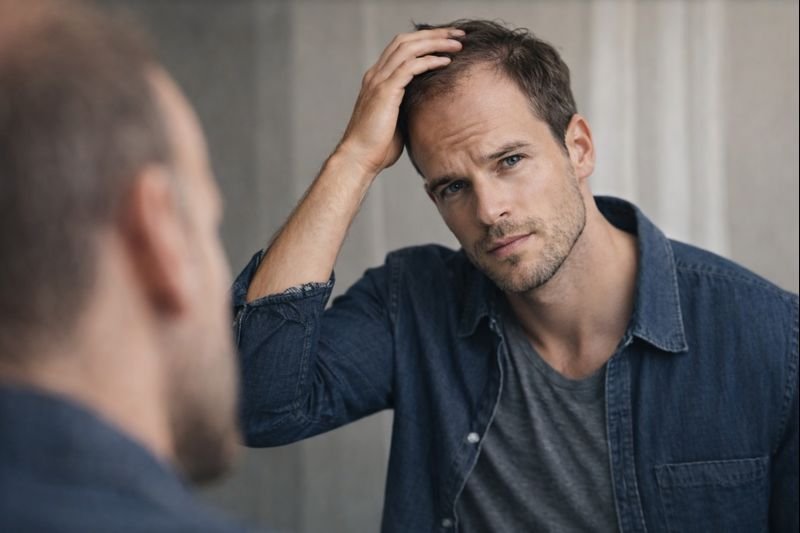
Persistent dandruff can irritate the scalp and trigger inflammation. If left untreated, this irritation may weaken hair roots and contribute to increased hair fall over time.
Noticing thinning hair or increased hair fall? Early diagnosis can help protect your existing hair and slow further hair loss. At India Hair Transplant (IHT), our dermatologists evaluate the cause of hair loss and guide patients to the appropriate treatment options.
Understanding hair loss is the first step in selecting the most suitable treatment approach. Medically, hair loss is a progressive condition that develops gradually over time, often starting with subtle thinning, decreased hair density, or changes in hair texture well before visible baldness occurs.
According to the International Society of Hair Restoration Surgery (ISHRS), male pattern baldness alone affects up to 50% of men by age 50. Similar progressive patterns are increasingly seen in women as well, often presenting as diffuse thinning across the scalp rather than clearly defined bald areas patches.
At India Hair Transplant (IHT), one of India’s top hair restoration clinics with centres in Delhi, Ludhiana, and Bangalore, we acknowledge that hair loss affects more than just appearance. For many people, it influences confidence, social interactions, and overall quality of life.
Every patient visiting our clinics undergoes a detailed hair and scalp assessment to determine the extent of hair loss and its underlying causes. Factors such as hair loss pattern, stage of progression, scalp health, follicle activity, and future risk are evaluated before recommending treatment. At IHT, hair loss is treated as a personalised medical condition, supported by dermatologist-led care, advanced therapies, and evidence-based treatment protocols.
Hair loss is a medical condition where hair follicles gradually lose their ability to produce healthy hair fibres. It happens when the balance between hair growth and shedding is disturbed, resulting in a visible decrease in hair density over time.
Each hair grows from a follicle beneath the scalp and follows a natural growth cycle. When follicles become weakened or sensitive, they start producing finer, shorter hair, a process called follicle miniaturisation. Over time, some follicles may stop producing visible hair entirely.
It is also important to understand that not all hair fall indicates hair loss. Losing approximately 50–100 strands of hair daily is typically part of the normal hair growth cycle and is called hair shedding.
However, when hair fall becomes persistent or is accompanied by visible thinning, widening of the hair part, or increased scalp visibility, it may indicate ongoing hair loss and requires proper medical assessment.
Several hair and scalp conditions can cause hair loss by affecting the health of hair follicles. Inflammation, infection, or chronic scalp irritation can disrupt normal hair growth and contribute to increased hair fall over time, often requiring proper diagnosis and medical hair loss treatment.
Persistent dandruff can irritate the scalp and trigger inflammation. If left untreated, this irritation may weaken hair roots and contribute to increased hair fall over time.
A chronic inflammatory scalp condition causing redness, greasy scales, and itching. Ongoing inflammation can disrupt the hair growth cycle and contribute to gradual hair thinning.

An autoimmune scalp condition that forms thick scaly patches. Inflammation and frequent scratching can stress hair follicles and increase hair shedding.

Inflammation or infection of hair follicles that appears as small painful bumps. If untreated, it may damage follicles and lead to hair loss in affected areas.
Hair loss is a heterogeneous condition. In some people, it develops slowly over many years, while in others it may appear suddenly or progress more rapidly. This happens because different types of hair loss have different underlying causes and affect hair follicles in unique ways.
Understanding the type of hair loss helps determine how it may progress, whether it can be controlled or reversed, and which treatment approach may be most suitable.
Androgenetic alopecia is a genetically driven form of hair loss caused by increased sensitivity of hair follicles to hormones such as dihydrotestosterone (DHT). It is the most common cause of hair loss in both men and women.
How it affects hair loss:
Alopecia areata is an autoimmune condition in which the immune system mistakenly targets healthy hair follicles, leading to sudden patchy hair loss.
How it affects hair loss:
Telogen effluvium is usually a temporary form of hair loss triggered by physical or emotional stress such as illness, surgery, childbirth, or nutritional deficiencies.
How it affects hair loss:
Anagen effluvium occurs when hair growth is abruptly interrupted during the active growth phase of the hair cycle, often associated with chemotherapy or radiation therapy.
How it affects hair loss:
Traction alopecia develops due to repeated pulling or tension on hair follicles from tight hairstyles or grooming practices.
How it affects hair loss:
Scarring alopecia refers to inflammatory conditions that permanently destroy hair follicles and replace them with scar tissue.
How it affects hair loss:

Hair loss can occur due to several underlying factors that affect the health of hair follicles and disturb the natural hair growth cycle. Understanding the common causes of hair loss helps identify the right treatment and prevent further progression.
You might be experiencing hair loss due to:
In many individuals, hair loss develops due to a combination of these factors, making proper diagnosis important.
Call 09779944207Hair loss is closely linked to changes in the normal hair growth cycle. Every hair follicle follows a continuous cycle of growth, transition, and rest, which allows old hair to shed and new hair to grow.
When this cycle functions normally, hair density is maintained. Hair loss develops when the cycle is repeatedly disturbed over time, affecting how hair grows and regenerates.
Duration: Typically 2 to 8 years
The anagen phase is the active growth stage during which hair follicles produce strong, thick hair strands. In a healthy scalp, nearly 85–90% of hair follicles remain in this phase.
When the anagen phase is shortened due to genetic sensitivity, hormonal imbalance, or nutritional deficiencies, hair may gradually become thinner and weaker with each growth cycle.
Duration: Around 2–3 weeks
The catagen phase is a short transitional stage where hair growth stops and the follicle begins to shrink and detach from its blood supply.
Only a small percentage of hair follicles remain in this phase at any given time, but it plays an important role in the natural hair growth cycle.
Duration: Approximately 2–3 months
During the telogen phase, hair follicles rest and hair growth temporarily stops. At the end of this phase, hair strands shed to make way for new growth.
Normally about 10–15% of scalp hair is in this phase. When too many follicles enter this stage prematurely, noticeable hair shedding may occur.

Hair loss is one of the most commonly managed concerns amongst hair restoration specialists in India. In some cases it can be reversed, but the outcome depends on the cause, stage of hair loss, and follicular health.
Clinical studies suggest that hair loss is more likely to be reversible when:
As hair loss progresses, follicles may gradually lose their ability to regenerate hair, making reversal limited or sometimes no longer possible.
At India Hair Transplant (IHT), dermatologists assess the hair growth cycle, follicle activity, and progression risk to determine whether hair loss is reversible, controllable, or permanent. This evaluation helps guide treatment decisions that focus on long-term hair health.
Hair loss does not progress the same way in every individual, which is why treatment needs to be medically planned rather than standardised.
At India Hair Transplant (IHT), hair loss treatment is guided by clinical outcomes, long-term results, and real patient success stories. Led by some of the best dermatologists in India with extensive experience in hair loss management, our team has helped thousands of patients achieve visible improvement in hair density, hair quality, and scalp health. We offer advanced hair restoration therapies such as PRP therapy, GFC therapy, Hair transplant and other customised medical hair loss treatments, supported by modern diagnostic tools and internationally recognised protocols.
Each treatment is planned after a detailed hair and scalp analysis, evaluation of follicle activity, and assessment of progression risk. This structured approach ensures therapies are chosen for safety, effectiveness, and realistic outcomes, with a clear focus on long-term hair and scalp health.
👉 Consult our hair specialists to evaluate your hair loss and discover the most suitable treatment plan for your condition.
Call 09779944207