Best non-surgical treatment recommended by doctors for early hair thinning and noticeable hair loss, designed to strengthen follicles and support natural regrowth.
PRP (Platelet-Rich Plasma) therapy is a doctor-advised treatment used to support hair and scalp health using components derived from the patient’s own blood. The concept of PRP did not originate in cosmetic medicine; it was first used in orthopaedics, sports medicine, and wound healing, where concentrated platelets were found to aid tissue repair through the release of natural growth factors.
With its ability to improve blood supply and cellular activity, PRP was later introduced into hair loss management to support existing hair follicles and improve scalp health. In its early years, PRP was often promoted as a potential “cure” for baldness; however, with growing clinical evidence, its role and limitations are now clearly understood. PRP does not create new hair follicles or restore hair in completely bald areas.
Today, PRP treatment in India and internationally is widely used because it is a non-surgical treatment for hair loss, minimally invasive, and relatively safe for men and women experiencing early hair thinning, diffuse hair loss, or increased hair fall. At IHT (India Hair Transplant), our dermatologists advise PRP as a supportive therapy rather than a standalone solution, either in the early stages of hair loss or alongside other treatments, as part of a long-term hair restoration planning approach.
PRP stands for Platelet-Rich Plasma, a concentrated component obtained from a patient’s blood that contains a higher concentration of platelets. Platelets are rich in growth factors that play an important role in tissue repair, blood circulation, and cellular activity.
In PRP hair treatment, this platelet-rich plasma is used to support the health of existing hair follicles. The growth factors help improve blood flow around the follicles and stimulate cellular activity in the scalp, creating a more supportive environment for hair strength and quality over time.
PRP works best for individuals with active hair follicles, where the goal is to support hair density and improve scalp health. It does not regenerate new hair follicles and is not effective in areas of complete baldness.
PRP hair treatment is a doctor-supervised procedure performed in a controlled clinical environment to ensure safety, sterility, and precision. The treatment plan is customised after a detailed scalp examination and assessment of the individual’s hair loss pattern.
The procedure begins with a detailed scalp evaluation to assess hair density, follicle health, and the pattern of hair loss. Based on this clinical assessment, the doctor designs a personalised treatment plan and identifies areas requiring targeted PRP application.
A small amount of blood (approximately 40–60 cc) is drawn using sterile techniques. The collected blood is then processed through centrifugation to concentrate platelet-rich plasma containing growth factors essential for hair follicle stimulation.
The scalp is thoroughly cleansed, and local anaesthesia is applied to ensure patient comfort. PRP is then administered through precise injections at pre-planned scalp points to ensure even distribution and controlled follicle stimulation.
Once introduced into the scalp, PRP releases growth factors that help improve blood circulation around hair follicles and activate cellular repair mechanisms, supporting stronger roots, improved thickness, and healthier scalp conditions over time.
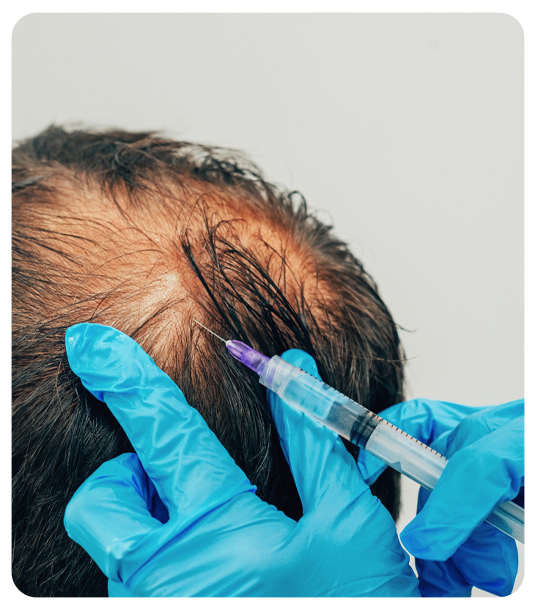
When advised for the right candidates and performed under proper clinical protocols, PRP therapy offers a safe, minimally invasive option with no major downtime and predictable outcomes. PRP works by delivering a concentrated dose of growth factors directly to weakened hair follicles, helping improve scalp health and strengthen existing hair over time.
PRP therapy for hair loss offers the following benefits:
PRP hair treatment is suitable for individuals with early-stage hair loss and active hair follicles and is commonly recommended by a dermatologist for hair loss after proper clinical evaluation.
PRP is not recommended for advanced baldness where hair follicles are inactive. Suitability for PRP treatment is determined by doctors after a detailed clinical assessment to ensure safe and realistic outcomes.
While medications and PRP therapy are commonly used to manage hair loss, they differ significantly in their mechanism of action, dependency, suitability, and long-term outcomes. Understanding these differences helps patients choose the most appropriate treatment approach.
| Aspect | Minoxidil | Finasteride | PRP Hair Treatment |
|---|---|---|---|
| Type of treatment | Topical medication (solution or foam) | Oral prescription medication | Non-surgical regenerative therapy |
| Primary action | Improves blood circulation and prolongs the growth phase | Reduces DHT levels to slow genetic hair loss | Delivers growth factors to stimulate follicle activity |
| Target concern | Early-stage thinning and hair fall | Androgenetic (DHT-related) hair loss | Weak follicles, thinning hair, reduced density |
| Onset of results | 3–6 months with consistent use | 3–6 months with continuous use | Gradual improvement over multiple sessions |
| Dependency | Results depend on ongoing use | Requires long-term or lifelong use | No daily dependency; performed in sessions |
| Effect on existing hair | Helps maintain and thicken miniaturised hair | Primarily prevents further hair loss | Strengthens existing hair and improves scalp health |
| Side effects | Possible scalp irritation or initial shedding | Possible hormonal side effects in some patients | Minimal when performed under medical protocols |
| Suitability for women | Commonly prescribed | Limited use, doctor-guided only | Suitable for both men and women |
| Long-term consideration | Hair loss may resume after stopping | Hair loss may resume after stopping | Supports hair preservation and quality over time |
NOTE: In many cases, doctors recommend a combination of treatments rather than relying on a single option.
The cost of PRP hair treatment in India is not fixed and varies from patient to patient, as PRP is a medical treatment where the protocol is decided only after evaluating the scalp condition, stage of hair loss, and treatment goals.
In India, the cost of PRP hair treatment usually ranges from Rs. 10,000 to Rs. 12,000 per sitting when taken as a single session. When PRP is planned as a treatment course, most clinics recommend a 3-session package, with the total cost typically falling between Rs. 25,000 and Rs. 32,000. The exact price depends on the treatment plan advised by the doctor and the clinical protocol followed.
Since PRP outcomes depend on proper case selection and medical expertise, a clinical evaluation is essential before confirming the final treatment cost.
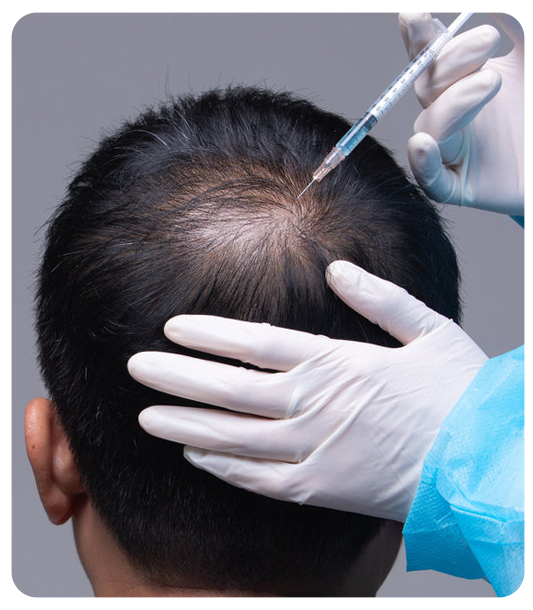
PRP hair treatment is generally considered safe when performed under proper medical supervision. Since PRP uses platelet-rich plasma derived from the patient’s own blood, no synthetic substances are involved, keeping the risk of allergic reactions low.
From a clinical safety and procedural standpoint, PRP hair treatment involves the following considerations:
PRP treatment outcomes may vary based on individual response, adherence to follow-up protocols, and continuity of care over time, which is why medical guidance plays an important role in treatment safety and effectiveness.
India Hair Transplant (IHT) is a reputed clinic for PRP hair treatment in India, known for providing quality hair care under the supervision of experienced dermatologists. The clinic focuses on delivering safe, medically guided, and consistent results at an affordable cost.
Before recommending PRP, every patient undergoes a proper hair and scalp assessment to evaluate the stage of hair loss, follicle activity, and overall scalp health. PRP is advised only when doctors feel it can genuinely benefit the patient and support long-term hair health.
At IHT, PRP is used as a supportive, evidence-based treatment, either for early hair loss or alongside other hair restoration options. The focus remains on preserving existing hair, improving scalp health, and achieving stable and realistic results over time.
👉 Book a consultation with our experts to understand whether a hair transplant is the right option for your hair loss.
Call 09779944207